Stance Training Form – Strong but Mobile (Master Deric Mims)

12 01 2015
From left to right:  Masters Reza Momenan, Master Deric Mims, and Master Hon Lee

From left to right: Masters Reza Momenan, Master Deric Mims, and Master Hon Lee

Senior Jow Ga Sifu Deric Mims, out of all of the Dean Chin students, was perhaps our lineage’s secret weapon. He is a unique character in American Jow Ga history, because unlike all the original Full Instructors, Sifu Mims joined following his mother. Other Jow Ga members–Howard Davis, Chris Henderson, Stephanie Dea and a few others–followed their fathers and older brothers; Deric’s mother was an advanced student of Dean Chin and one of his original “fighting women”, as I recall him saying. In the American Kung Fu community, Jow Ga stood out due to the fact that our school’s foundation was not standing on Chinese community members–but mostly African American and Latino–many female students who were just as good, just as strong as the men, and put out fighters rather than forms competitors. Sifu Mims had an eye for detail, perhaps better than Sifu Chin himself, and under his direction, Jow Ga students could do more than fight–Jow Ga students could present our forms well while adhering to the standards any self-respecting fighter would have for himself. Some of Jow Ga’s best forms competitors owed their skill to Sifu Deric without compromising the combative nature of Jow Ga.

Few Jow Ga websites make reference to Deric Mims for various reasons, but no one can deny that without his instruction and his ideas–DC Jow Ga might have become just another Kung Fu fighting school whose forms no one notices. Often, schools that focus on fighting perform their system’s forms poorly. To do both well is rarely found in the community. Unfortunately, the Chinese Martial Arts community has yet to evolve to a level where an African American Sifu can be recognized as a Master without making a movie or promoting himself in media. For this reason, I refer to Deric Mims as a best-kept secret in Jow Ga–if American Jow Ga can be categorized into sublineages, Sifu Mims’ Jow Ga has its own identity and uniqueness due to his talent. One cannot give a proper history of DC Jow Ga without paying homage to him and his leadership. About 5 years before his death, Sifu Chin named Deric the Jow Ga Association’s President and senior instructor. He ran the promotion exams. He conducted the business of the school, making Jow Ga a professional organization. He oversaw demonstrations, tournament performance, and kept the lights on. Even if Jow Ga members did not attend Sifu Mims’ classes, we were all impacted by his mark on the system.

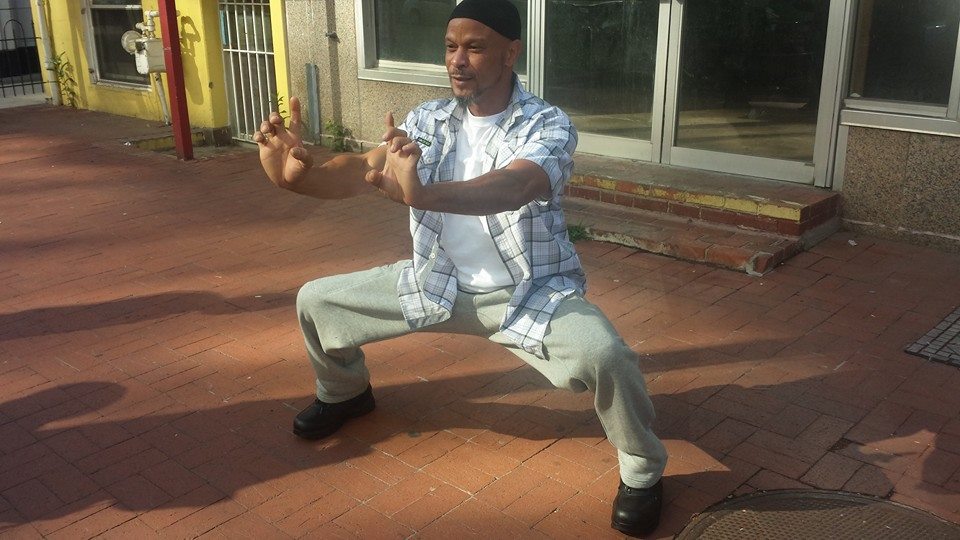
One of those major contributions is the Stance Training Form, or as some would call it–the “Stepping Form”.

The Stance Training Form was a foundation form Sifu Mims created to teach basic footwork, balance, and movement to new students. Regardless of one’s prior experience, this routine taught our basic stances and how those stances are used in movement–from advancing in short bursts as well as full steps, to retreating, to hopping, twisting, sinking, rising, and flanking. No student could touch our first form without first learning it. Few schools pay this kind of attention to footwork and foundation, other than learning to hold stances. In Jow Ga, whose head is Hung and tail is Choy, one must incorporate strong stances even while in motion. Few Kung Fu practitioners can do this. By observing any forms division in the TCMA community, from beginner to advanced, you may notice that forms might open with low stances and close with low stances. But stances will be high and mostly non-existent, save for a few pauses and poses. Not so with Jow Ga foundational training. Even our strongest fighters will have solid stances. And stances must be strong, but mobile–unlike many who teach that footwork would be strong OR mobile…

Not many Jow Ga schools today utilize the Stance Training Form due to philosophical or business reasons. However, a few have preserved the form, including mine (Maurice Gatdula). The video below is our version of this form, with a few changes and the addition of the “Wheel Punch Form”, also choreographed by Sifu Mims, at the end of the form. Jow Ga students in this lineage must train the form for 9 months to a year and be able to perform the routine ten times in one set before moving on to Siu Fook Fu (Small Subduing Tiger), our first form.

Stay tuned, Jow Ga students, as the Federation will be releasing a DVD soon teaching this form. Thank you for visiting the DC Jow Ga Federation.



2014 in review

5 01 2015

The WordPress.com stats helper monkeys prepared a 2014 annual report for this blog.

Here’s an excerpt:

A New York City subway train holds 1,200 people. This blog was viewed about 5,300 times in 2014. If it were a NYC subway train, it would take about 4 trips to carry that many people.

Click here to see the complete report.


Kung Fu’s “Changing Times”

24 12 2014

Let’s organize this article differently first. I would like to introduce the conclusion first, then the body. That should make this interesting….

Like it or not, Kung Fu is changing. It isn’t the “old days” anymore. You are now a dinosaur. Yes, you probably can’t relate to today’s Sifu–and especially today’s students. But guess what? These arts are older than the word “old”, and there was a time that some Sifu looked at what you called the “old days”, shook his head, and couldn’t relate. Bottom line… The martial arts is an ancient, but ever-changing, art. The key to staying relevant is to realize what the changes are, and to find a way to make the most of those changes.

Edit:  Instructor Charles Kwok (Hung Gar teacher in Richmond, Canada. He studies Mok Kwai Lan Hung Gar under Sifu Joseph Kwok, and Wang Kiu Wing Chun under Sifu Ray Van Raamsdonk) posed the following statement:

Been watching a few documentaries about different styles of kung fu. Many of them talk about the old days in Hong Kong. I noticed a common phrase they would use and that is “In the old days, life was hard.” So life was hard back then, the economy wasn’t great, so people had to work. However, they also all talk about how students would still show up to the school and practice hard. Nowadays I keep hearing people say that they have to work and therefore miss class. Kind of confusing if you asked me.

Something we often hear in the Chinese martial arts is how much older the Chinese arts is than other arts. We love to brag about how the Chinese culture birthed the “mother martial art” to other countries’ arts and other styles. On the other hand, there are many who consider Chinese martial artists as guys stuck in the past, who refuse to allow their arts to change and evolve. Even many that are considered classical and outdated (compared to modern/mixed styles) look at the Chinese martial artist and think how useless our arts happen to be. At the same time, the two groups may not realize that the other is here to stay, and both groups are as valid as any other. A good analogy is to look at the acceptance of rap music in American pop culture. When rap music was born, many thought it a fad that would be isolated among African American urban youth (even older African Americans scoffed at it)–and now look. Hip Hop culture is the single most influential form of pop culture in the world. While the African American may be seen as a second class citizen in America–Hip Hop culture as a subculture of the African American community has influenced music, dress, behavior, standards of beauty on every continent on the planet. Likewise, both MMA and Chinese martial arts are found in everything from the fitness industry, to fashion, to children’s cartoons, to applications in health care, and in every form of media.

Like I said, you just have to find your place.

The old days saw martial artists who were die-hard fanatics. People walked on the street wearing martial arts uniforms. My colleagues and I even passed up college educations to study the martial arts full-time. We took whatever abuse our teachers dished out in class, trained until our knuckles bled, and if we broke a bone–we took off the cast and fought in tournaments. One thing our Masters could count on… tomorrow night, regardless if it was Christmas Eve, we were hurt, or the lights were cut off–we were coming to class. Fighters were even tougher. They fought anyone anytime anywhere, and no one bickered over money. You accepted whatever the promoter was willing to pay, regardless of the rules or how long you had to train. The only thing that mattered was there was an opponent and I wanted to prove that I could beat him. Today? HUH! Fighters cancel fights because they got hurt in training. Go figure…

Teachers lament the caliber of students we attract today. When I came to Jow Ga in the 80s, my Sifu told my family I was too young–and I was 11. We visited three times, and had it not been for my Si Hing Raymond Wong, I might have gone to another school. But today’s Sifu is promoting kids younger than 11 to Sifu (and they call that a “Black Sash”, whatever that is). 😉  Today’s student is lazy, worried that he might get hurt, impatient, thinks the Sifu works for HIM since he is paying him, will quit if work gets busy/he gets married/has a child/finds a kwoon with more convenient classes or lower rates. Today’s student is younger, more fickle and impulsive, thinks he knows everything, will research your system’s history and argue that Shaolin is a fable and Da Mo didn’t create kung fu, blah blah blah….

But we have to understand that even the Kung Fu Sifu has changed, along with the art and the student, as well as how we run our schools. First of all, more information is available to students today than it was 30+ years ago. You have students who research all over the world via the internet before walking through your doors. Hell, with Youtube, I wouldn’t be surprised if guys joined your schools already knowing your school’s first form! The economy demands that teachers take on more students than he needed to 40 years ago. At one time, Kung Fu was only for the tough, and either you were strong enough to handle the training, or your took your sissy self to a dance studio. You can’t do that today, where rent is $2,000/month and students who get hurt will sue you. The martial arts, if it is to survive in today’s economy, must cater to the masses to a point. Either that, or you have a class for the average guy walking through your door–and a separate class for the hard-core students. Many of us have not found that middle ground, so we are either suffering financially or making a living but unable to put out the quality that our own Masters did. We also must understand that today’s student is more educated, probably has more on his plate than yesterday’s student, and has far more teachers and schools and lineages to choose from. Simply put, it takes more effort to retain students than it did yesteryear. We also must find a way to make what we do more relevant to the lives of the types of students we encounter today.

Teachers often have to decide if they will focus on fighting, form, competition, lion dance, fitness, children, street self-defense, or simply preserving the art. Yes, it is possible to do all of the above. However, there are far more Sifu in every city than there was 30 years ago when our Masters arrived on these shores (wherever “these shores” happen to be). Competition is fierce. Students are also more critical. When I lived in Baltimore in the 90s, I took students to a tournament and fought as a light weight. I won my division, but as usual, I lost to a larger opponent for Grands. Matter of fact, I sometimes beat the heavyweights, but found problems with faster-but-still-stronger middle weights. No biggie, Guro lost a match, and Monday it’s back to the grind at the school. Yet, today, a loss could mean a loss of students, as we real guys must compete against Masters who have claimed to have never lost a fight and movie characters who could beat 10 men, etc. There wasn’t pressure on teachers in the 80s to fight and be a champion, but in today’s community we have several “World Champion 10th Degree Grandmasters” in every city! Advertising is not as easy as it was years ago when you could simply say you teach Kung Fu and people joined. Today, you need to be slick, have a nice logo/slogan, claim a high rank, dress your school up like a Shaolin temple or MMA gym… It’s just not as bad a thing as it seems. Kung Fu in Hong Kong in the 60s is unlike in the hometown its masters came from in the 40s. Kung Fu systems under the founders are unlike they are today, even 20 years ago under your Grandmasters. We just have to find where the martial arts fits in the society we live in–then find a way to apply our knowledge in that society… not much different than finding out how techniques from the form must be applied when fighting for your life. In a way, the martial arts aren’t supposed to stay the same from generation to generation. So, the next time we point a finger at younger Sifus and shake our heads, remember that once upon a time, some old, grumpy Sifu pointed his finger at us and shook his head. 🙂

Yeah, you’re right, times have changed.

Thank you for visiting the DC Jow Ga Federation.


The “Tools” of Kung Fu Weapons

21 12 2014

Sam Jeet

Attend any open tournament and one would probably find that “Chinese Style Weapons” is possibly the most interesting division. Our schools are decorated with them. Any CMA style has a larger variety of them than most other systems. As students, we are excited at the thought of learning each new, exotic weapon as we progress through the ranks.

But what purpose does learning these arts serve? Besides the obvious “cool” factor, what is the practical benefit to learning the kwan dao, the gim, the sern bin, the sam jit gwun? If you’re like the rest of us, you have the canned answer that “learning all these weapons allows the kung fu man to pick up any object and use it for self-defense purposes”. Come on, you know you say it. Hell, most of our Sifus put it on flyers. Some of you probably added, “–have you seen a Jackie Chan movie?” (lol)

Mostly, I agree with you. Learning such weapons as the steel whips, the double dagger, and the humble-but-king-of-weapons:  the lowly staff–will give the martial artist a foundation that will enable almost anything in his hand to turn you into a one man tornado of death. 🙂  However, we must add that it won’t be automatic. The way most of us practice weapons actually won’t give you those butt-kicking skills. You might be offended, but the way most of us were trained, you probably can’t even pick up a broadsword and kick someone’s butt with it. It’s all in how you actually view these weapons.

If you look at kung fu weaponry the way a mechanic views his tools, then you are on the right track. Unfortunately, most martial artists do not. We see a Kung Fu weapon as a cheerleader’s baton, or a set of pom-poms. Some of you treat your three sectioned staffs as musical instruments–the floor is the drum, and your weapon as drumsticks. When looking at Traditional Chinese Martial Arts weapons demonstrations, there will always be someone asking the perplexing question, “Yeah, but can you fight?”

(pause)

Well, can you?

Looking at how most TCMA practitioners practice with their weapons, an actual match with the weapon would leave the average Kung Fu man stumped. Honestly, most of us have NEVER sparred with our weapons. We know forms with the weapons. We can “demonstrate” (quotation marks added for emphasis) application, as long as our partner doesn’t actually try to attack us. But fight with these things, we’ve never really done. So we are relying on the same thing as the McDojo students with our supposed ability with our skill… We hope these skills will work, but in reality we don’t actually know. Because of the price on these weapons, we don’t even practice our 2-man sets with any real intent. You and I both know, if you’ve actually done a 2 man set with intensity, that going through the form ONCE with power and intensity you’ll completely ruin a good set of weapons.

When a mechanic learns to change an alternator, he knows the first thing he should do is to test the alternator before telling a customer to spend his money. His knowledge of other skills within the automechanic field will help him do this, in the same way a Kung Fu man must have knowledge of other skills in fighting and combat will enhance his ability to use his weapons. The mechanic knows that he must disconnect his battery for a reason. He must have certain tools on hand to loosen bolts, to pry the alternator from it’s space, to remove the belt… Some tools will have various uses in varying stages of the work. And each vehicle will have a different process to the job, although the outcome may be the same.

For the martial artist, there are universal principles with the weapon. There are some techniques that are emphasized for specific weapons, just as there are techniques that cannot or should not be used with those weapons. Some skills can be applied to other weapons; some cannot. Skill with each weapon must be learned, trained and developed individually. Skills with the Kwan Dao may seem like those of the Cheung, but knowing how to use to the Kwan does not mean you are skilled with the spear. A slash with the gim is very different from a slash with the dao. You must understand the nuances and intricasies of each weapon. They are different weapons that require specialized skill, and although they may complement each other–they are separate, yet related, skills. For the martial artist to simply learn a weapons form as an item on his system’s curriculum without deep insight, training and research is to do one’s system a disservice. Form is not enough.

I would like to offer some tips to assist you in your search for more understanding of your system’s weapons:

  • Divide your weapons form into attacks, defenses, and counterattacks. Some techniques may have alternative applications and uses
  • Identify foundation skills with that weapon. For example, the 8 attacks with the Staff, three pokes with the Spear, and five blocks with the short swords. These foundational skills must be trained regularly and individually as skills–not just as part of the form
  • Practice the foundation skills more than you practice the form
  • Identify uses for your weapon in combat:  to break bones, to throw the opponent, to stab organs, to cut or destroy limbs, to disarm the opponent, to destroy the opponent’s weapon… These things are your weapon’s “tools”
  • Find a simulated way to practice your weapons, so that you can beat the weapon up without having to replace a $200 sword every few weeks. One suggestion is to use toy plastic bats for your double broadswords
  • Speaking of double broadswords, have you ever struck anything full power with yours? I have, and it taught me a lot about the use of that weapon. Try it, and you will find that there are many intricasies to learn when employing your weapon full power. A fight is the wrong place to discover how difficult it is to swing a weapon with bad intentions
  • Find an Eskrima tournament, a Cold Steel tournament, an SCA event, or a Chanbara tournament. These are some great places to put your weapons ability to the test without getting hurt, and can be eye-opening. There are people who have one-upped the TCMA community with weapons skills, we really need to get out there and find out what I’m talking about
  • Put together some safe sparring in your schools for your students to try out their weapons skills. It’s another level to aspire to in the martial arts, and many of us are unaware that this level even exists
  • Bridge the gap between what works in sparring and what’s found in your form. Believe it or not, the gap in the Chinese martial arts is actually very small. Most of what is in our systems works; we just need to discover how they work. Getting a feel for these weapons in an environment other than a choreographed form

Many schools have a very good grasp on the use of weapons for fighting. Overall, I believe that the Wing Chun community and the Choy Lay Fut community have done a very good job of doing so with their weapons work. For most of us, we have limited our knowledge and skill to simply the skill of performing a form–and there is so much more in the arts than that. Please take this advice and discover for yourself a whole new world within the Chinese martial arts, even if you realize that you may be a novice… and take your Kung Fu to another level.

Thanks for visiting the DC Jow Ga Federation.


Clouding Your Kung Fu Mind

11 12 2014

A conversation I have often had with Kung Fu practitioners is that I lament the diluting of Chinese martial artists these days. In the traditional Chinese martial arts–the TCMAs–we have two extremes in modern times. On one hand, there are the highly idealistic practitioners who teach exactly as they learned it without modifying or modernizing anything. They practice only forms, fight from a cat stance if they fight at all, and basically have no idea how to fill the needs of the average person seeking self defense. At the far right of this discussion, we have the SanDa/San Shou practitioner who loves to fight. Regardless of what system he studies, his entire repertoire looks exactly like every other fighter at the events he frequents. He may be a Tong Long student, a Hung Gar student, a Wing Chun student–but in the gym he looks like a Muay Thai guy. Kung Fu just doesn’t seem to be Kung Fu anymore.

But somewhere in the middle there are the rest of us, who do a mixture of traditional training and modern methods. We shadowbox, we do roadwork for our wind, but we also practice our Sei Ping Ma, Chi Sao and use the all metal Kwan Do for our strength training. Our forms may have a little extra zing in it, based on our taste and research as modern students of the art. We may do our techniques with the fist rather than the Fu Jow because it seems more practical. We may have boxed for a few months to gain an understanding on how that style of fighting works–and then import those lessons to our Choy Lay Fut.

All those things are good, but please, don’t cloud your Kung Fu mind, or you run the risk of diluting your system.

Before I get jumped on by the guys at the Kung Fu online forums, here’s a test:

Can YOU fight using only techniques from your system’s first form? No jabs, no round house kcks, no clinching… Just the techniques from your first form’s techniques?

If not, read on.

This is my point. Many of us love our systems and we have a few bread and butter techniques that we hold dear to. Most of us, however, have almost nothing in the form that we actually use in sparring or street fighting. Those of us who can fight, most likely use what every other guy uses. We have boxing punches, Muay Thai kicks, and jujitsu takedowns. Our mind simply cannot wrap itself around the idea of taking our classical techniques and fighting a mugger at the ATM with them or taking them into the ring. I have a Si Hing who was a boxer before joining Jow Ga, and he used his background in applying his Jow Ga. I respect him, I honor him and his version of Jow Ga, but I believe there is another level that the art could have been taken to and that is where I arrived to this philosophy. Chinese martial arts systems are very valid forms of fighting and they really don’t need to be cross pollinated with other styles of fighting. To do so is not bad; I do it myself. But I understand that there is a dimension that I must strive for and for the last ten years, my personal journey in Jow Ga has been guided by this idea. Any system’s first form can be broken down into bite-sized pieces of gold and used in fighting without any help from outside systems. The hard part is making it happen. Once you do so, you will understand your system better than most other practitioners. Give yourself six months of foreign system-free training, and see where it takes you.

Thank you for visiting the DC Jow Ga Federation.



Critique the Master

2 12 2014

Ah, yes. Analyze the master, even if you have to find fault with the way he did things. Understand that no man (or woman) is above reproach, and as long as we are human there will always be room for improvement. We strive for perfection, but no man should ever believe he has arrived at that point. For the moment you believe you have perfected the martial arts, you have just initiated your demise. Perfection, my brothers, is a never-ending, always out of reach plateau. You may get near it, you may realize you are approaching it, but the closer you reach perfection, you will realize a new goal or challenge. In order to become the perfect martial artists, you must always be in pursuit of it.

(My #1 gripe with Bruce Lee fans, btw–many hurt their own growth because they believe in Lee’s doctrine without question, without deviating from his path when the man was 32 years old…)

If your Sifu has done his job right, the day you become a full instructor, you should be the absolute best product he could produce. We martial arts teachers are a curious bunch. We honor our Masters and teachers by hoping to become the best Kung Fu fighters we can, but in order to do so, we must improve our teachers and their systems. We are often friendly and cordial with each other, but inside our minds, we think we are better than the next guy and do our best to show it. Some of us actually call each other up and tease each other about being better. Some of us take it personal and actually dislike our “competition”. Some of us are in competition with our own brothers. My Si Hing Chris Henderson and I used to kill each other with insults because he owned a Kung Fu school and I worked for a commercial Dojo. When I encountered his students in tournaments I would tell my students to get those “Wu Shu artists”. Another Si Hing of mine would call me a traitor whenever he saw me in a Karate uniform point fighting, telling me I was playing Tag. I would tease another Si Hing, Ron Wheeler, for being a break dancer in a Kung Fu uniform–and he’d tease me about the time he popped me in the nose when we fought at American University (I won lol). My Baltimore friends, who represented four different styles, were my opponents every month in tournaments up and down the 95. Through all of this, we sought to improve ourselves and improve each other through friendly (and not-so-friendly) competition. Yet the one person with whom we should also compete against is the person we often refuse to oppose: Our own Masters.

If we teach our respective styles without acknowledging the potential or need for improvement, our system will not improve. How can you teach your students to develop an unstoppable attack if we do not understand where our weaknesses lie? How can you give your students an impenetrable defense if you do not also teach them how they can potentially be beaten? In the Filipino martial arts, there is a term called “counter for the counter”. When you teach an attack, you must identify the possible counters to that attack, then you must learn how to counter that counter. In other words, in order to understand your system better, you must understand how to beat the system your Master taught you. Many of you are not psychologically ready to face this. Too many believe that their system cannot be improved. Too many believe it would be disrespectful to question what your Sifu taught, or if they had made any mistakes when they taught you. I would suggest that your Sifu very likely improved the art his own Sifu taught him when he taught you, however. Very few of us teach exactly as we were taught. Most of us have our own specialties, our own weaknesses, and things that we like in the art. Doesn’t it make sense to personalize our Hung Gar, our Wing Chun, our Tong Lung, our Choy Lay Fut–so that our students can get the best we can offer?

There are few ways to do this without changing your Sifu’s curriculum. One way is to omit those things you cannot do well. Another is to send your students to various classmates who can perform skills in your system better than you can. You can also elect to emphasize some skills and forms more than others, based on your own taste. But more often than not–you will have to change many things to fit your own individuality as a teacher, and your student’s learning ability, physical limitations or gifts, and needs.

When formulating your school’s lesson plans, it would be very fair to your student to find the most efficient, effective means to results that you can. Our teachers did not know everything. We must admit that. Of course, we respect our masters, but we do them a disservice by idolizing them and deifying them to the point that their legacy is ruined because we are too much in adoration to allow their art to grow. Don’t simply take the training plan you had as a student and regurgitate it without thought. Think of things that you and your classmates struggle with. Is there a way to make it easier to learn? Was there something in your Sifu’s school that caused a many students to drop out? It isn’t fair to just say they were “losers” or “weak”. Did you have classmates who did not get results? Have you found many instances of beginners becoming better than advanced students? Or, let’s just cut to the chase… Can you find a better way to teach than your teacher? Is there anything in the curriculum that is impractical, needs an overhaul, or needs to be emphasized? You are now the Sifu, give your students what they are paying for!

This is one reason I am not in favor of newly made Sifus being allowed to leave right out and open schools. Either that, or we should give instructor candidates ample time to work out those things out before getting in front of a student body. Once the instructor-student has learned the art, he or she may need time to fully absorb and understand the system before it is presented and taught to new students. We want to be fair to our students, and our students’ students by making sure that the art we are giving them has been absorbed, tested, developed and revised. New Sifus must be comfortable enough with the art–with his teacher’s art–to look at it with a critical art, and not be afraid to say, “I’ve improved my teacher’s art.” It is not a slap in your Sifu’s face to say that. In fact, it is a compliment. You are saying, “Sifu, I have learned your art and I have found a way to make it fit me better.”

Saying so means that your Sifu has done more than just taught a student; he has created a confident and wise Sifu-student who has become more than just a certified instructor, he has become a peer.

Thank you for visiting the DC Jow Ga Federation.


Kung Fu and the Pursuit of GREATNESS

18 11 2014

The Chinese martial arts is not a dying section of the martial arts world. Listen to a so-called “modern/tactical/CQC/street-oriented/sports” enthusiast–and one would think that we are. The martial arts, like all skills and arts, must find relevance and adjust to the change of times…. it’s just that simple. Perhaps many of us have not learned to do this. Maybe some of us are stuck in the 70s, stuck in the Hong Kong days, or stuck in the 1800s. But dying? No.

Boxing could be said to be a dying sport. They once said that about the art of wrestling; yet when former wrestlers started beating BJJ and Muay Thai fighters in the MMA arena that art found new life (and fans) didn’t they?

Kung Fu practitioners in their 30s and older may in fact be stuck in the Shaw Brothers or Golden Harvest era, when most of the world began to discover the difference between Chinese and Japanese arts. Yet as the average person’s exposure to the arts increased and we now have non-martial artists who know how to throw basic martial arts techniques it is no longer enough to simply be exotic. In the 1980s, a Kung Fu guy could do a nice form and ramble off lineage for credibility–today, he needs to be able to do a thing or two on the floor with an opponent to convince his peers that he’s the real deal. This is where many of us fall short; this is why many other stylists dismiss the Kung Fu guy as “forms guys”…

You know what I’m talking about. Go hit the local open tournament. Kung Fu people in the morning doing forms and weapons, walking around with their chests puffed out. Hell, even many of us prancing around in sleeveless jackets and sporting muscles and studded bracelets. But when the Pee Wees have finished with their forms and toothpick gwun and aluminum-foil dao forms, all those Tai Chi, satin-with-frog-button, and tough-guy southern style jackets get traded in for T-shirts and school jackets just in time to sit in the bleachers and talk about how the karate guys are just “playing tag” and aren’t doing real fighting. But at the same time, those Karate guys are making the same dismissive comments about us. And when you attend a Chinese style-only tournament–pretty much the only place you’ll find a lot of Kung Fu guys fighting–you see the same playing tag and unreal fighting, just sloppier. If you happen to run up on a Kung Fu tournament with some full contact (and I discover this happens even more these days), most of the hard core fighters are sporting MMA or Muay Thai gear.

Tell me I’m wrong.

It’s pleasing to see that Kung Fu fighters have become more competitive these days. It would just be nice to see more Kung Fu guys become competive with Kung FU. Am I right, am I right, or am I right? Why should a Kwoon need to be influenced by MMA to actually introduce some toughness and fighting spirit? In each local CMA community, there only seems to be a small handful (oftentimes, one) of schools whose Sifu aspired to become great–to become dominant–over the other schools. Not just dominant over other Kung Fu schools, but to be the best school around the city. Often, this is the Sifu who never put out a video tape series, or never wrote articles on himself. He is sometimes disliked by other Sifu in town. He may have been the youngest of them. His history or credentials might have been questioned. He may have been the newest, ignored Sifu on the block many years ago, and he used that slight to fuel his desire to show the other guys up. And 20 years later, his guys are the killers of the community. <—-  And THIS is what I think happened, Kung Fu comrades…

See, we have spent the last 30-40 years training lackadaisically. We did not compete with one another. We judged each other by measuring lineages and timelines rather than win/loss records. We focused on keeping the “less-than-authentic/less-than-fully-Chinese” schools away from the Chinese New Year celebration, rather than turning our focus inward and trying to produce the best generation of students and fighters we can. We shied away from tournaments (and certainly the ring) and our students never had much to compare themselves to, and with nothing to sharpen our blades against, too many Kung Fu schools live up to the “Soft Style Division” that “Hard Style” tournament promoters deem us. We’ve gone so far from the tradition of one-upmanship that makes for great martial artists, and we’ve become the school that teaches Kung Fu for discipline, good grades, living in harmony, longevity, blah blah blah…. anything but fighting and self defense. We’ve convinced our students (and ourselves) that fighting is not the point, and that although we train as if we will never need our martial arts–if the day came when we actually DID need it–when some guy with a brick or a knife or some friends who want your wallet, all of that horse stance training and learning postures and push hands will miraculously save your ass. Even though the only bloody nose you’ve suffered in training was when some guy slipped up and did it by mistake and Sifu admonished him for using too much power in Chi Sao practice (sigh).

Training for no other reason but to make another Kung Fu practitioner look like a fool is bad. Training for no other reason but to make yourself look good is bad. However, we must still train to make another Kung Fu practitioner look like a fool and to make us look good is good–if the ultimate goal is to strengthen your skill and reach a level of dominance and really reap the self defense and combative benefits of all this training and study. Forget trying to look like you are humble, who cares what you look like? Humility is good, but does you no good if you have commited your life to the martial arts and you have no skills to keep you safe on the street. Yes, there are many of us who don’t do this for fighting. For those martial artists, they should take the words “self defense and combat” off their websites and business cards and flyers. But if you are in the business of keeping people safe, we must do away with the rhetoric and outdated, dying practices and get back to the 21st century. Your lineage means everything, but it also means nothing. Give your students what they really think they’re getting. Start practicing for greatness, so that you can produce great martial arts students. It all starts with seeing who is best between you and the next guy, then once you find out, you continue to outdo each other, until you are both great. This is how the Chinese martial arts community will get its respect in the field, not by sitting in small circles and pointing to everything except real skill.

Bring back the competitive spirit into Kung Fu. Thank you for visiting the DC Jow Ga Federation.


A Sei Ping Secret…. (sshhh!)

10 10 2014

Occasionally, on this blog we will be sharing some “little known DCJG facts”. I say this sarcastically, because whenever I share them in class around non-Jow Ga friends, they always seem amazed by simple things that all DC Jow Ga students know… and these little known DCJG facts exist in their systems, are so obvious and simple, and shouldn’t amaze anyone who teach the martial arts.

I would like to emphasize that nothing here is secret; they are in every style. You probably teach it in your system. Each time you teach a beginner some of these things, I’m positive you tell him this very thing–without the emphasis.

Without the Emphasis

“Without the emphasis” is where Dean Chin’s Jow Ga is different. There are many details in Kung Fu that are taught, but not emphasized. For example, in Southern styles when we shift from the Sei Ping Ma (Horse Stance) to the Jee Um Ma (Bow and Arrow/Front Stance), everyone tells students that the shift adds power, speed and reach to an attack. However, only in schools where the Sifu emphasizes that element of making the shift increase power, increase speed and increase reach–will those benefits find their way into the strategic advantage of a fighter’s arsenal. The teacher must emphasize this in both form and fighting also. Too many teachers teach the shift, tell of the many benefits and advantages and details, then on to the next move or the form… In Dean Chin’s Jow Ga, these minor details are dissected, studied, developed and emphasized in the student’s skill until they become habit. It must be more than a talking point. Each detail of a technique, each alternate application, each variation, each benefit, must all be identified, separated from the form and practiced and drilled as a separate skill.

I “emphasize” for emphasis:  As a separate skill.

Today’s little known DC Jow Ga fact:  The punching hand that retracts is pulling a grabbing arm into the opponent while punching with the opposite arm.

I don’t even know you, but I know that when you teach the Horse Stance Punch, you tell the student at some point that the non-punching hand “can pull the opponent in if he grabs your arm”. The question is, how much time do you spend practicing it? If you are like most martial artists, you will teach punching like this:

Lop Jin… Sei Ping Ma. Horse Stance Punch, ready? YAT. YEE. SAM. SEI….

And you do this, every time you teach punching ^^. Not us. We do this to practice punching. But in almost every session practicing punches, we do something with the opposite hand–Eagle Claw grab and punch. Tiger Claw rake and punch. Counter grab the opponent’s hand and punch. Yank the hand back (this article’s “secret”) and punch. Grab the opponent’s lapel and punch.

Get it? You pull the non-punching hand back with as much power as the punch going out. That’s it. I won’t tell you how to do this, just that it needs to be done if you want to practice the way we do.

If you want to know more, please find a DC Jow Ga teacher (look on our Blog Roll for a school near you) and study with him. Or you could order our Small Tiger DVD (shameless plug).

Thank you for visiting the DC Jow Ga Federation!


Moe’s Still Got It (Longevity in Kung Fu)

30 09 2014

Craig Horse stance

Also known as “Craig’s Still Got It”…

It’s taken me 5 months to write this article.

So, in the months we’ve started this blog, we have gone from three guys (Ron Wheeler, Sharif Talib, and Maurice Gatdula) discussing shining a light on Dean Chin’s memory, to rounding up the legends of American Jow Ga and locating old friends and family, to planning an American Jow Ga family reunion like you wouldn’t believe. In all of this, I have made an observation that I cannot make about my other martial arts family–my Filipino Martial Arts family:  Everywhere I look, I see men in their 50s and 60s who look great. Not just “great for their age”–which is an insult to all the hard work and discipline these folks have put into still maintaining their health–but amazing in that they have maintained their youthful vibrance into an age where men are beginning to die of old age and health problems. By contrast, in the other martial arts circles I run in, I have noticed that bellies, beards and health problems run amok in men who have barely left their prime.

Even in other Chinese martial arts families I have known, the sense of athleticism isn’t there. The competitive nature of the family members isn’t there. The feuds we have isn’t even there, in the way that we have them. And I have a theory.

Chinese martial artists are always talking about “longevity” and “vitality”–ideals that most martial artists give lip service to, but few really pursue. So what are these things anyway? Is it just the endeavor to live a long life?

Martial Arts in its purest state is at its core a means of self-preservation. To some, it simply means the will to remain alive. To others, it is the effort to remain alive. There is a difference. In the same way martial artists can take a passive approach to their craft, they can also elect to take a very aggressive, assertive, proactive approach to the art. Self defense can deflect an attacker with the simple desire to get away and stay alive–or it can be an action verb, to stay alive and eliminate the attacker. The two mentalities are not the same and I submit to you that they are not equal. A passive approach for the martial artist may fail. In fact, it is highly possible that it will fail should the passive martial artist encounter an extremely hostile, violent opponent. Fighting involves more than simply knowing techniques and being able to use them. Fighting is often psychological, where one man is trying to take the life of the other. In this case, the only way to stop him would be to render him incapable of continuing to fight; this method most likely will involve crippling, maiming of killing the opponent. Passive martial artists dislike this kind of talk. They believe that a man hell-bent on taking your life can be subdued and stopped relatively unhurt using the correct technique and appropriate amount of force.

On the other side of this philosophy is the idea that one must be prepared to kill his opponent, to break his bones, to permanently disfigure him, to crush his windpipe, to put his eye out his socket… Whatever it takes to stop the opponent and eliminate the threat. The more violent the opponent or opponents, the more violent the reaction. This is a mindset, not a set of techniques. In teaching students this very specialized skill, you must also teach him the thinking of one who must use these techniques. One cannot simply teach a form with such techniques, teach him a method of performing the routine in an aesthetcially pleasing manner and leave it at that. You must condition the student to be able to hurt the opponent with these skills without hesitation. You must train him until he is not physically inferior to the attacker. You must make him mentally and emotionally tough so that he knows when to use the skills and can do so without feelings of guilt. He must be tolerant of pain and fear. He must believe that he cannot be defeated and believe that he is superior to his attackers. Only then, can a martial arts practitioner be capable of facing two or three men prepared to do him harm and send them to the hospital while he goes home safe.

So, you betcha there is a heirarchy of martial arts philosophies. One is passive and in denial about what combat really is, while the other understands that combat is not a noun, but an action verb. One teacher simply wants to live a long life, while the other wants to stay alive. One trains as a prescription to old age and poor health–and the other trains as if his life depended on it. One takes care of his body so it will still carry blood and oxygen for years and years, while the other wants to become as strong and durable and youthful as it ever was. Both will live a long time. Both are still martial artists. Perhaps one does it because he simply wants to live until he is 90. While the other may be motivated by ego or vanity–he clearly wants to live until he is 90 and hear the words, “Moe still got it.” He wants to still do the things he did as a young man when he is older. He doesn’t want to simply live, he wants to live with life pumping through his veins. They both never plan to retire, but one takes a passive approach to his aging self and the other holds on to his youth.

If you round up a group of 20 former casual martial artists, meaning they never competed, never fought to be the best, never engaged in the rat race of martial artists with an ego–all in their 50s–you will likely find men who no longer “do” martial arts. They may teach, own schools, etc., but they most likely don’t fight, compete in tournaments, and so on. They will likely be out of shape and full of health problems. On the other hand, round up a group of 20 former competitors, fighters and champions–you will most likely find the opposite. Surely, there will be bald heads and some pot bellies. But more often than not, you will find men at an advanced age, who still have “it” like they did when they were young. Because men like this can never walk away from the martial arts and the question we always ask when we are around another guy:  “I wonder if I can take him?”  <—- And this question keeps men like myself, Ron Wheeler, Sharif Talib, Craig Lee training so that, decades later, when people finally run into you, they just shake their head saying, “Yeah, Craig still got it…”

The late Master Dean Chin’s approach to Jow Ga was not that Kung Fu is a party art. It was not for the masses. It was not something we did for certificates and rank. It was a path to guaranteed preservation. Preseveration in combat when you’re young, and the side effect of that is that your youth will be preserved when you are older. It’s not enough to just still be here. You want to be here, just as strong, just as full of life as you’ve ever been. Longevity, then, if you are training your Kung Fu for the same reasons we do, if a means to bottling up the young man within you and keeping hold of it while you’re old.

If you ask me, this group of Kung Fu men (the youngest one is 45, by the way) are a fine looking bunch. Thank you for visiting the Dean Chin Jow Ga Federation.

Raymong Wong, Hon Lee, Kenny Chin

Raymong Wong, Hon Lee, Kenny Chin

Kenny Chin, Ricardo Ho, Craig Lee, and Ron Wheeler

Kenny Chin, Ricardo Ho, Craig Lee, and Ron Wheeler

Kenny Chin, Raymond Wong, Chris Henderson, Ron Wheeler, Ricardo Ho

Kenny Chin, Raymond Wong, Chris Henderson, Ron Wheeler, Ricardo Ho


My Book: Make a Living with Backyard Dojo

24 07 2014

Let’s change the topic for a second. I’m assuming that the average reader of this page is a traditional Kung Fu teacher who does not run a commercial kwoon/dojo. You don’t want to be an alternative day care center. You don’t want to sell rank every three months. You don’t want to water down classes to keep everyone’s interest. Your Sifu taught you form, Lion Dance, fighting, even how to teach–but he didn’t teach you how to make money with Kung Fu did he?

Of course not. Our Sifus did this for love of the art and propogation of the system, and chances are pretty good that you did too. However, you have to have money to make keep the school (and ultimately the system) going, right? There are plenty of books, courses and seminars to teach the McDojo owner how to run his business–but about about you? The traditional, hard core, Sifu? There isn’t much. Perhaps you don’t even own a school. You’re enrollment is small. You don’t have $499 to plunk down on a Guerilla Marketing course. What is a Sifu to do?

Well… I’ve written a small book, which my editor calls a “mini-book” because it’s only 22 pages long. I wrote it for the Masters of small, independant martial arts schools who would like to feed their families with their schools. These are not men who want hundreds of students and million-dollar high-tech dojos. They are true to tradition, in both skill and business practice, and the most they want is to open a humble commercial location that pays the bills and puts food on the table and their kids through college.

I have invested thousands of dollars trying to learn the business side of the martial arts. I’ve been talked into offering a belt system, utilizing contracts, teaching in day care centers (seriously), teaching seminars on tour, even opening satellite classes across the country. I have taught in the middle east, in central america, as well as in sober living homes. All this, in pursuit of wanting nothing more than to afford teaching the real art to my most dedicated students while these other ventures paid my bills. My ultimate goal back then was to offer my training for free. I learned a lot about business, and learned a lot about how I can market and run my business without doing what everyone else does.

Anyway, the one thing I noticed was that I could not find business information that was directed at a guy like me–who teaches full contact; who uses profanity in my classes; who yells at students; who has ex-cons and gang bangers in my classes; a man whose students (including children) leave the school bruised, banged up, bloodied, and sometimes in need of stitches. Yes, I have insurance. Yes, I pay taxes. And yes, there is a market for my type of martial arts. I have a website, I’m in the Yellow Pages, occasionally I am on the radio and on cable TV, and I don’t promise good grades.

I have seen many good friends and good martial artists who have closed shop because they did not have the business tools to stay in business. One of the painful reminders of this, was a fear years ago, when I had refused several students of a friend’s dojo who attempted to join when they saw the writing on the wall. 6 months later, they were there after his school closed, and then he stopped teaching out of his garage. I’ll say this here, and some of those students read this blog, but I thought as traditional Karate teachers in Sacramento go, he was absolutely the best… even better than me.

So I wrote this book for you guys. The guy who surfs the net looking for ways to keep his school going while his wife urges him to “get a real job”. The guy (who, like I once was) working for minimum wage on a graveyard shift job in order to keep a school. The guy (like I was) who used money from tournament winnings to pay bills because his enrollment was too low to pay rent and eat.

I was asked to make it at least 40 pages, but I had a message to give, and it came out to 22 pages. Sorry Mike! I didn’t want to fluff it up or pad with filler just to make it seem “worth the money”… I know people who teach their martial arts that way. You’ll find that the other books I write will be the same way: short, to the point, but full of good, useful information. And I am not some young, wet-behind-the-ears MBA who knows nothing about what the real business world is like. Just like I am not some 50-something millionaire Karate clown trying to convince you that you’re not legit unless you’re selling belt exams and birthday parties.

If you want to really put bread on the table with good, quality martial arts, this book is for you. Look at our “Offerings” page off the main page, and you’ll see ordering information there. Please, leave comments or at least email me to give me feedback after you’ve read it!

Thank you for visiting the DC Jow Ga Federation.