My Style’s Too Deadly

21 11 2015

A Kung Fu guy, a Karate guy, a Jeet Kune Do guy, a Streetfighting guy, a Jiu Jitsu guy, and a Ninja guy walk into a tournament. The one who can’t fight goes, “My style’s too deadly.”  The rest of the group smacks him upside his head, and they all have a good laugh. The end.

Okay, my joke telling skills aren’t that good. 🙂

But it is a long-standing joke that martial artists who can’t fight love to throw out that “My art’s too deadly” reason to shunning competition. As if your respective style doesn’t have backfist, side kick, round kick, straight punch, etc… Or, as if you only engage in death matches.

Here’s the thing:  ALL styles are too deadly for competition. Hell, look at Paint Ball. What’s more deadlier than small arms combat, and they even have found a safe way to practice! Martial arts tournaments were not designed to simulate the battlefield. However, if you wanted a place to test the few safe techniques in your system without risking broken bones, crushed windpipes, dislocated knees–the tournament is the way to go. Either you can block a punch or kick or you can’t, and a 3 minute, hit-him-five-times-or-lose match is a great way to find out really quick if you have the timing and speed to stop a punch or kick. So what some guys are slapping–block the slap. The good old straight punch to the ribs is still legal, so take the shot!

I believe in the 1960s all martial arts on these shores were on equal ground. However, the Karate and Tae Kwon Do schools engaged in competition and honed their arts into something that was more practical than when they first arrived–and Chinese stylists sat in the bleachers ridiculing it until, six generations later, you are hard pressed to find more than three Kung Fu schools in each city willing to slug it out, regardless of the rules.

Let’s define something, by the way, as I’m sure some will object to my use of the expression “more practical”:

In saying Karate/Tae Kwon Do becoming “more practical” over the years, I am saying that as time went on, those arts moved away from prearranged practice into a type of practice that is more suitable for fighting on the street. Yes, tournament techniques are somewhat unrealistic. But today’s point fighters are faster, more athletic, have better reflexes, trickier, and have more strategies up their sleeves than their Grandmaster’s generation.

Back to my point. Kung Fu practitioners have good fighting techniques within every style. The problem is that too many schools over emphasize forms practice and do not engage enough in sparring for students to have the attributes needed to bridge what they do in forms practice with what they do in fighting practice. As a result, we see Kung Fu people studying Muay Thai and abandoning their style’s specialty. Kung Fu people putting opponents in the guard when their system calls for breaking arms and legs. Kung Fu people politely declining offers to have a friendly match, and later exclaiming to friends that their art was designed for killing, not acquiring points.

Even if your system has no punches and only eye gouges and throat smashes, you still need speed and timing to catch an eye before an opponent can turn his head. Even if your system has no hook punches or elbow techniques, you still need to know how to defend against a hook punch or elbow to the face. This is why sparring against foreign systems is absolutely necessary, because each form of fighting–from the lightest contact sparring division to the body slamming San Shou competition–delivers a different set of skills to the Kung Fu fighter who engages in it. You are not going to learn to take jabs by hitting mitts with a classmate. You are not going to learn to avoid leg kicks–or learn to manuever after eating a few Charlie-horse-inflicting thigh kicks–unless you’ve actually faced a man attacking your legs. Your Sifu teaches you techniques, but opponents teach you how to fight.

No clever conclusion here, that’s it. Understand, that every Kung Fu student needs to engage in combat with unfamiliar faces and styles if he is to take your art to the next level. Yes, we are all training to cripple, maim or kill. But we need safe places to test out the few skills we can if those skills are to be reliable when we need them.

Thank you for visiting the DC Jow Ga Federation.


The Two Fatal Mistakes of Teaching Kung Fu

21 11 2015

We have the art of doing Kung Fu, and then there is the art of teaching Kung Fu.

While closely related, the two are not equal, and as the cliche goes–skill in one does not equate to skill in the other. We are going to take this discussion to a deeper level than the normal generic explanation. I believe that not fully understanding the development of Kung Fu skill in oneself versus the development of Kung Fu skill in a student have terrible consequences. It could very well be the perfect explanation for the state of Chinese Martial Arts today. Please hear me out, before making a judgment about this view.

Mistake #1–Thinking there is no more to learn

In the Filipino arts is an expression, that the moment one believes his skill is “good enough” that martial artist’s skill begins to decline. There is always another level to an ever-growing onion.  In the martial arts, many focus on the attainment of rank. We foolishly refer to this pursuit as “finishing the system”, and then neglect to dig deeper than our own teacher’s research within an art. There are several ways to make this mistake:

  • Learning the forms of the system, and little else
  • Develop fighting skill that is completely unrelated to the skills of one’s system
  • Neglecting to utilize techniques from your system’s forms in fighting
  • Denial of, or shunning, the value of competitions and tournaments
  • Refusing to learn from another teacher or another school–even within your own system–or its inverse–
  • Adding more arts and systems to your repertoire arbitrarily
  • Immediately transitioning from learning the system directly to teaching the system
  • Failing to realize that your own personal skill in Kung Fu can become stronger, faster, more accurate, more instantaneous, and sharper
  • Desiring to keep the system exactly as it was taught to you, with no innovations or alterations or personalization

Simply put, many teachers have undertaken their teaching career prematurely. They are passing on to their students a snapshot of the classroom from the days when Sifu was a student, with no development or changes from Si Gung to Sifu to student. What a disservice! When the teacher believes there is nothing more to learn, he fails to see the beauty on the other side of the mountain. When going uphill, it is difficult to see that there is another plateau to the mountain. We often fail to reach the summit when we stop to rest and believe we’d gone “far enough”. It is only when we are never satisfied, always hungry for more, never tiring or becoming bored with our climb that one day we do actually reach the top. It is at this point, you are standing at the top and can see the bottom of the mountain on both sides, and realize that you’ve arrived. And here’s the thing about arriving at the point of mastery:  It always comes long after you thought you would, and no man can take you there. <— This is my problem with schools that award “Master” rank to a student. You simply cannot. Mastery is a climb that one must make alone. It is a point of self-realization that many others may not share with you–nor will they agree that you have arrived. But don’t worry, the reason most men do not believe you have arrived is because they have not reached that summit themselves, and did not accompany you. At the same time, men who have been there themselves will know, because they’ve seen what you’ve seen, they’ve tasted the bitter cold, the thin air, felt the burn in their thighs, and recognize the psychological high you share with them after reaching the peak.

This is the reason I believe most men abandon martial arts perfection in order to pursue easier goals that are more pleasing to the ego. Things like rank, titles, additional styles, multiples of ranks in other systems (without actually study–these men gain them through correspondence courses and weekend seminars), publicity and fame and popularity. They embellish accomplishments because they have none to be proud of. They are prone to rivalries and severed relationships. They abandon families and start their own groups to do it their way. They deny their histories and pretend to have traveled another path. Few men have earned their way to the title of Master, so they find ways to do it the quick, easy way–or they simply wait until they are too old to be questioned on their skill, and use Age-as-rank to strap on that title.

But a mediocre young man only grows into a mediocre old man. And this is the point where we begin our descent to the other side of the mountain, and the second flaw.

Mistake #2–Thinking there is more to teach

Teachers try to be everything to everyone. I recall a meme I had recently seen on social media. Something to the effect of “Martial arts teachers, aka career counselors, aka marriage counselors, aka dietician, aka historian, aka child disciplinarian, blah blah blah”.

How foolish. We are martial artists. And to explain it to a non-Martial Artist, that could mean one or several of many things:

  • A fighting coach
  • A fitness coach
  • An educator
  • A bodyguard
  • A surrogant parent
  • A cultural center curator
  • A tournament fighter’s coach
  • A self-defense expert
  • blah, blah, blah

It is either ignorance or arrogance for a teacher to think he knows it all. We simply do not. Life is too short for a Sifu to be a self-defense expert, a kickboxing coach, a fitness expert, a weight loss specialist, a chiropractor, an expert on ADHD, a weapons expert, etc.  If we are a true “Master” of the arts, there must be something we specialize in, within our arts. Perhaps we can teach the fundamentals of many things. But carry every student to the point of mastery in every aspect of our arts is not just foolish, it is dishonest. As a master, I must represent to my students that I have “mastered” everything in my system and know those things better than most of my peers. Honestly, no man can make that claim. This is how I believe Kung Fu styles ended up with so many weapons forms–while the Founder may have studied one or two weapons with a true master, 150 years later his system is teaching 15 weapons. In the meantime, all students get is a form with that weapon, and nothing more. Yet Kung Fu websites all boast 9, 10, 15 weapons. One can’t possibly excel at all of them.

What have you spent your career doing, within the arts? Fighting? Performing exhibitions? Performing Lion Dance? Kicking? Punching? Kickboxing? Teaching?

Yes, after 30 years of study in the arts, most of us should be qualified to call ourselves an “expert” in our respective styles. But an expert in what? Yes, you may know 40 forms, but you can’t possibly have mastered all 40 forms. I know close to 50, and I have spent nearly all of my Kung Fu training practicing 9. If a Jow Ga student came to me and wanted to learn the best of my Jow Ga, I would be cheating him to spend any length of time with forms other than those 9. Can I teach them? Sure, I can. If he wanted to perfect them–it would either be a solo effort, with me supervising–or I would send him to another Jow Ga Sifu whom I know has already perfected that skill. I love Lion Dance and can teach it. However, if an advanced student of mine loved it and wanted to perfect his ability and knowledge I would have to send him to another Si Hing once I had shown him all I knew.

And that, brothers and sisters ^^, is the point of the second fatal mistake in Kung Fu. Not realizing that one’s knowledge is not infinite. We must understand our limits, and be confident in our skills, but humble enough to know when we can not teach a student further than the boundaries of our knowledge and experience. We got a good example of this in last week’s fight between Ronda Rousey and Holly Holm, when Rousey’s trainer attempted to teach her how to defeat Holm, who was an expert stand up fighter. Rather than understand his limits as a coach, he attempted to do it alone rather than bring in a real expert at stand up to take Rousey to the next level. I have seen the man move, and I can tell you, Ronda was training with a man she can beat.

Now, how many times have you seen Kung Fu Sifus bring students to a full-contact competition when that Sifu has never fought full contact himself?

I hope you get my point.

We can teach our students what we know, and what we’ve developed. However, we must also admit to ourselves what we are truly proficient and knowledgeable in, and limit what we teach to those things. If you find that that you need more research, keep training and climbing. Sometimes, you may need to climb more than one mountain. Sometimes, you reach old age while still climbing mountains. Pass the torch on to your students when you can no longer climb mountains, and let them elevate your art after you have taken it as far as you can go.

To recap, you must first develop and research and master you art as far as you can. Then secondly, you must teach what you know best–the heavily concentrated version of the best of your Kung Fu knowledge–to your students, and enlist other Sifus if you must. This is what keeps Kung Fu pure and strong–not pretending to know everything when you don’t.

Thank you for visiting the DC Jow Ga Federation.


Tempering Your Kung Fu (Dojo-Busting)

2 09 2015

There is an ongoing debate in the Chinese Martial Arts world–in America, particularly–about what direction Kung Fu needs to go towards. I don’t live in a town with many real Kung Fu schools (there are only about 5 or so), and out of those schools none fight on the circuit where I would meet and bond with them. Over the years, and recently on social media, I have engaged in this discussion with enthusiasm.

My philosophy is the same now as it was in the late 1980s when I began teaching Jow Ga:  Kung Fu people must modernize their view of their martial arts.

Notice I said we must modernize our view, and not modernize our styles.

Lately, I’ve come to enjoy another blog discussing the Chinese martial arts, NY Sanda–run by Master David Ross. He is a student of the late Master Chan Tai San, practicing Choy Lay Fut, Lama Pai, Bak Mei and Jow Ga. Sifu Ross is one I consider to have kept up with the times. I approach my modernizing slightly differently than he does, but I do not disagree with any of his methods. When you get a chance, make sure to get over there and see what he is up to. He is a Sifu that I believe if a challenger walked in his door, that challenger would be leaving with some body parts rearranged. We can’t say that about too many Kung Fu teachers.

When I say that we should modernize our view, I am referring to how we treat our arts. How we train, and what goals we set for the fighting skills we teach, are vital to whether our arts are outdated or useful. Too often, Kung Fu practitioners value their arts by how many forms they know, how well they perform a form, or how popular/famous they or their teacher is. But Kung Fu is not measured in those things in the mind of a non-practitioner. We do our systems a disservice when we cannot easily relay what we do to a non-martial artist in terms they understand. The non-CMA guy doesn’t care who our master was, how popular our style is in other countries, where we got write ups.

In the modern world, the usefulness of a Kung Fu school is measured by:

  1. Combat usefulness on the street or the ring
  2. Its relevance for health–REAL benefits like weight loss, lifestyle changes, mental health benefits, and repairing/healing the body
  3. Works the Kung Fu school has done for the community. Not for paying students, but the community. Basically, does your school’s presence benefit those who are NOT members?
  4. How the students’ experience in your school has enhanced their lives once they are no longer attending classes
  5. The respect other martial artists will have for your lineage and your system after encountering you and your students

Some things to talk about and consider. Ponder on this, and I will expound in the next few articles. I estimate this to be at least a five-part series.

Thank you for visiting the DC Jow Ga Federation.
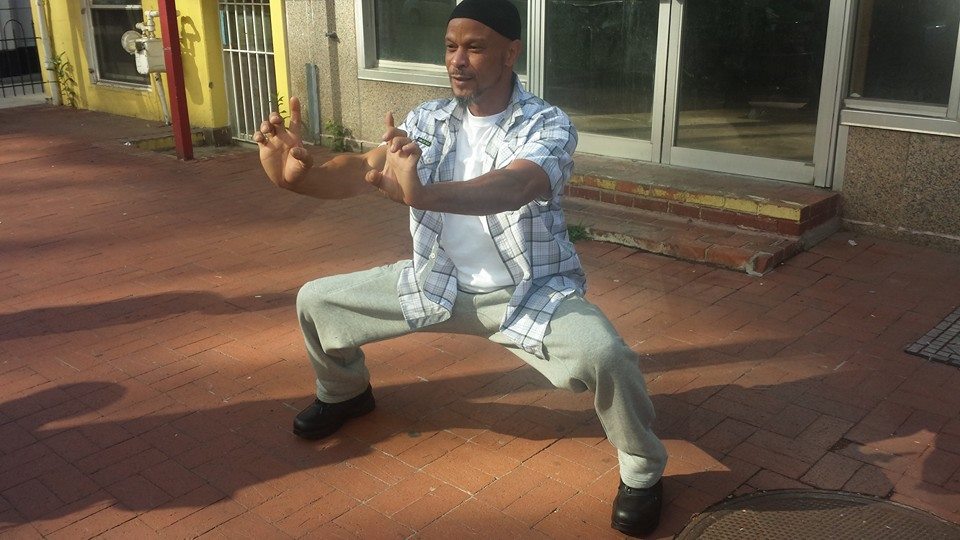


Stance Training Form – Strong but Mobile (Master Deric Mims)

12 01 2015
From left to right:  Masters Reza Momenan, Master Deric Mims, and Master Hon Lee

From left to right: Masters Reza Momenan, Master Deric Mims, and Master Hon Lee

Senior Jow Ga Sifu Deric Mims, out of all of the Dean Chin students, was perhaps our lineage’s secret weapon. He is a unique character in American Jow Ga history, because unlike all the original Full Instructors, Sifu Mims joined following his mother. Other Jow Ga members–Howard Davis, Chris Henderson, Stephanie Dea and a few others–followed their fathers and older brothers; Deric’s mother was an advanced student of Dean Chin and one of his original “fighting women”, as I recall him saying. In the American Kung Fu community, Jow Ga stood out due to the fact that our school’s foundation was not standing on Chinese community members–but mostly African American and Latino–many female students who were just as good, just as strong as the men, and put out fighters rather than forms competitors. Sifu Mims had an eye for detail, perhaps better than Sifu Chin himself, and under his direction, Jow Ga students could do more than fight–Jow Ga students could present our forms well while adhering to the standards any self-respecting fighter would have for himself. Some of Jow Ga’s best forms competitors owed their skill to Sifu Deric without compromising the combative nature of Jow Ga.

Few Jow Ga websites make reference to Deric Mims for various reasons, but no one can deny that without his instruction and his ideas–DC Jow Ga might have become just another Kung Fu fighting school whose forms no one notices. Often, schools that focus on fighting perform their system’s forms poorly. To do both well is rarely found in the community. Unfortunately, the Chinese Martial Arts community has yet to evolve to a level where an African American Sifu can be recognized as a Master without making a movie or promoting himself in media. For this reason, I refer to Deric Mims as a best-kept secret in Jow Ga–if American Jow Ga can be categorized into sublineages, Sifu Mims’ Jow Ga has its own identity and uniqueness due to his talent. One cannot give a proper history of DC Jow Ga without paying homage to him and his leadership. About 5 years before his death, Sifu Chin named Deric the Jow Ga Association’s President and senior instructor. He ran the promotion exams. He conducted the business of the school, making Jow Ga a professional organization. He oversaw demonstrations, tournament performance, and kept the lights on. Even if Jow Ga members did not attend Sifu Mims’ classes, we were all impacted by his mark on the system.

One of those major contributions is the Stance Training Form, or as some would call it–the “Stepping Form”.

The Stance Training Form was a foundation form Sifu Mims created to teach basic footwork, balance, and movement to new students. Regardless of one’s prior experience, this routine taught our basic stances and how those stances are used in movement–from advancing in short bursts as well as full steps, to retreating, to hopping, twisting, sinking, rising, and flanking. No student could touch our first form without first learning it. Few schools pay this kind of attention to footwork and foundation, other than learning to hold stances. In Jow Ga, whose head is Hung and tail is Choy, one must incorporate strong stances even while in motion. Few Kung Fu practitioners can do this. By observing any forms division in the TCMA community, from beginner to advanced, you may notice that forms might open with low stances and close with low stances. But stances will be high and mostly non-existent, save for a few pauses and poses. Not so with Jow Ga foundational training. Even our strongest fighters will have solid stances. And stances must be strong, but mobile–unlike many who teach that footwork would be strong OR mobile…

Not many Jow Ga schools today utilize the Stance Training Form due to philosophical or business reasons. However, a few have preserved the form, including mine (Maurice Gatdula). The video below is our version of this form, with a few changes and the addition of the “Wheel Punch Form”, also choreographed by Sifu Mims, at the end of the form. Jow Ga students in this lineage must train the form for 9 months to a year and be able to perform the routine ten times in one set before moving on to Siu Fook Fu (Small Subduing Tiger), our first form.

Stay tuned, Jow Ga students, as the Federation will be releasing a DVD soon teaching this form. Thank you for visiting the DC Jow Ga Federation.


Clouding Your Kung Fu Mind

11 12 2014

A conversation I have often had with Kung Fu practitioners is that I lament the diluting of Chinese martial artists these days. In the traditional Chinese martial arts–the TCMAs–we have two extremes in modern times. On one hand, there are the highly idealistic practitioners who teach exactly as they learned it without modifying or modernizing anything. They practice only forms, fight from a cat stance if they fight at all, and basically have no idea how to fill the needs of the average person seeking self defense. At the far right of this discussion, we have the SanDa/San Shou practitioner who loves to fight. Regardless of what system he studies, his entire repertoire looks exactly like every other fighter at the events he frequents. He may be a Tong Long student, a Hung Gar student, a Wing Chun student–but in the gym he looks like a Muay Thai guy. Kung Fu just doesn’t seem to be Kung Fu anymore.

But somewhere in the middle there are the rest of us, who do a mixture of traditional training and modern methods. We shadowbox, we do roadwork for our wind, but we also practice our Sei Ping Ma, Chi Sao and use the all metal Kwan Do for our strength training. Our forms may have a little extra zing in it, based on our taste and research as modern students of the art. We may do our techniques with the fist rather than the Fu Jow because it seems more practical. We may have boxed for a few months to gain an understanding on how that style of fighting works–and then import those lessons to our Choy Lay Fut.

All those things are good, but please, don’t cloud your Kung Fu mind, or you run the risk of diluting your system.

Before I get jumped on by the guys at the Kung Fu online forums, here’s a test:

Can YOU fight using only techniques from your system’s first form? No jabs, no round house kcks, no clinching… Just the techniques from your first form’s techniques?

If not, read on.

This is my point. Many of us love our systems and we have a few bread and butter techniques that we hold dear to. Most of us, however, have almost nothing in the form that we actually use in sparring or street fighting. Those of us who can fight, most likely use what every other guy uses. We have boxing punches, Muay Thai kicks, and jujitsu takedowns. Our mind simply cannot wrap itself around the idea of taking our classical techniques and fighting a mugger at the ATM with them or taking them into the ring. I have a Si Hing who was a boxer before joining Jow Ga, and he used his background in applying his Jow Ga. I respect him, I honor him and his version of Jow Ga, but I believe there is another level that the art could have been taken to and that is where I arrived to this philosophy. Chinese martial arts systems are very valid forms of fighting and they really don’t need to be cross pollinated with other styles of fighting. To do so is not bad; I do it myself. But I understand that there is a dimension that I must strive for and for the last ten years, my personal journey in Jow Ga has been guided by this idea. Any system’s first form can be broken down into bite-sized pieces of gold and used in fighting without any help from outside systems. The hard part is making it happen. Once you do so, you will understand your system better than most other practitioners. Give yourself six months of foreign system-free training, and see where it takes you.

Thank you for visiting the DC Jow Ga Federation.



Kung Fu and the Pursuit of GREATNESS

18 11 2014

The Chinese martial arts is not a dying section of the martial arts world. Listen to a so-called “modern/tactical/CQC/street-oriented/sports” enthusiast–and one would think that we are. The martial arts, like all skills and arts, must find relevance and adjust to the change of times…. it’s just that simple. Perhaps many of us have not learned to do this. Maybe some of us are stuck in the 70s, stuck in the Hong Kong days, or stuck in the 1800s. But dying? No.

Boxing could be said to be a dying sport. They once said that about the art of wrestling; yet when former wrestlers started beating BJJ and Muay Thai fighters in the MMA arena that art found new life (and fans) didn’t they?

Kung Fu practitioners in their 30s and older may in fact be stuck in the Shaw Brothers or Golden Harvest era, when most of the world began to discover the difference between Chinese and Japanese arts. Yet as the average person’s exposure to the arts increased and we now have non-martial artists who know how to throw basic martial arts techniques it is no longer enough to simply be exotic. In the 1980s, a Kung Fu guy could do a nice form and ramble off lineage for credibility–today, he needs to be able to do a thing or two on the floor with an opponent to convince his peers that he’s the real deal. This is where many of us fall short; this is why many other stylists dismiss the Kung Fu guy as “forms guys”…

You know what I’m talking about. Go hit the local open tournament. Kung Fu people in the morning doing forms and weapons, walking around with their chests puffed out. Hell, even many of us prancing around in sleeveless jackets and sporting muscles and studded bracelets. But when the Pee Wees have finished with their forms and toothpick gwun and aluminum-foil dao forms, all those Tai Chi, satin-with-frog-button, and tough-guy southern style jackets get traded in for T-shirts and school jackets just in time to sit in the bleachers and talk about how the karate guys are just “playing tag” and aren’t doing real fighting. But at the same time, those Karate guys are making the same dismissive comments about us. And when you attend a Chinese style-only tournament–pretty much the only place you’ll find a lot of Kung Fu guys fighting–you see the same playing tag and unreal fighting, just sloppier. If you happen to run up on a Kung Fu tournament with some full contact (and I discover this happens even more these days), most of the hard core fighters are sporting MMA or Muay Thai gear.

Tell me I’m wrong.

It’s pleasing to see that Kung Fu fighters have become more competitive these days. It would just be nice to see more Kung Fu guys become competive with Kung FU. Am I right, am I right, or am I right? Why should a Kwoon need to be influenced by MMA to actually introduce some toughness and fighting spirit? In each local CMA community, there only seems to be a small handful (oftentimes, one) of schools whose Sifu aspired to become great–to become dominant–over the other schools. Not just dominant over other Kung Fu schools, but to be the best school around the city. Often, this is the Sifu who never put out a video tape series, or never wrote articles on himself. He is sometimes disliked by other Sifu in town. He may have been the youngest of them. His history or credentials might have been questioned. He may have been the newest, ignored Sifu on the block many years ago, and he used that slight to fuel his desire to show the other guys up. And 20 years later, his guys are the killers of the community. <—-  And THIS is what I think happened, Kung Fu comrades…

See, we have spent the last 30-40 years training lackadaisically. We did not compete with one another. We judged each other by measuring lineages and timelines rather than win/loss records. We focused on keeping the “less-than-authentic/less-than-fully-Chinese” schools away from the Chinese New Year celebration, rather than turning our focus inward and trying to produce the best generation of students and fighters we can. We shied away from tournaments (and certainly the ring) and our students never had much to compare themselves to, and with nothing to sharpen our blades against, too many Kung Fu schools live up to the “Soft Style Division” that “Hard Style” tournament promoters deem us. We’ve gone so far from the tradition of one-upmanship that makes for great martial artists, and we’ve become the school that teaches Kung Fu for discipline, good grades, living in harmony, longevity, blah blah blah…. anything but fighting and self defense. We’ve convinced our students (and ourselves) that fighting is not the point, and that although we train as if we will never need our martial arts–if the day came when we actually DID need it–when some guy with a brick or a knife or some friends who want your wallet, all of that horse stance training and learning postures and push hands will miraculously save your ass. Even though the only bloody nose you’ve suffered in training was when some guy slipped up and did it by mistake and Sifu admonished him for using too much power in Chi Sao practice (sigh).

Training for no other reason but to make another Kung Fu practitioner look like a fool is bad. Training for no other reason but to make yourself look good is bad. However, we must still train to make another Kung Fu practitioner look like a fool and to make us look good is good–if the ultimate goal is to strengthen your skill and reach a level of dominance and really reap the self defense and combative benefits of all this training and study. Forget trying to look like you are humble, who cares what you look like? Humility is good, but does you no good if you have commited your life to the martial arts and you have no skills to keep you safe on the street. Yes, there are many of us who don’t do this for fighting. For those martial artists, they should take the words “self defense and combat” off their websites and business cards and flyers. But if you are in the business of keeping people safe, we must do away with the rhetoric and outdated, dying practices and get back to the 21st century. Your lineage means everything, but it also means nothing. Give your students what they really think they’re getting. Start practicing for greatness, so that you can produce great martial arts students. It all starts with seeing who is best between you and the next guy, then once you find out, you continue to outdo each other, until you are both great. This is how the Chinese martial arts community will get its respect in the field, not by sitting in small circles and pointing to everything except real skill.

Bring back the competitive spirit into Kung Fu. Thank you for visiting the DC Jow Ga Federation.


Moe’s Still Got It (Longevity in Kung Fu)

30 09 2014

Craig Horse stance

Also known as “Craig’s Still Got It”…

It’s taken me 5 months to write this article.

So, in the months we’ve started this blog, we have gone from three guys (Ron Wheeler, Sharif Talib, and Maurice Gatdula) discussing shining a light on Dean Chin’s memory, to rounding up the legends of American Jow Ga and locating old friends and family, to planning an American Jow Ga family reunion like you wouldn’t believe. In all of this, I have made an observation that I cannot make about my other martial arts family–my Filipino Martial Arts family:  Everywhere I look, I see men in their 50s and 60s who look great. Not just “great for their age”–which is an insult to all the hard work and discipline these folks have put into still maintaining their health–but amazing in that they have maintained their youthful vibrance into an age where men are beginning to die of old age and health problems. By contrast, in the other martial arts circles I run in, I have noticed that bellies, beards and health problems run amok in men who have barely left their prime.

Even in other Chinese martial arts families I have known, the sense of athleticism isn’t there. The competitive nature of the family members isn’t there. The feuds we have isn’t even there, in the way that we have them. And I have a theory.

Chinese martial artists are always talking about “longevity” and “vitality”–ideals that most martial artists give lip service to, but few really pursue. So what are these things anyway? Is it just the endeavor to live a long life?

Martial Arts in its purest state is at its core a means of self-preservation. To some, it simply means the will to remain alive. To others, it is the effort to remain alive. There is a difference. In the same way martial artists can take a passive approach to their craft, they can also elect to take a very aggressive, assertive, proactive approach to the art. Self defense can deflect an attacker with the simple desire to get away and stay alive–or it can be an action verb, to stay alive and eliminate the attacker. The two mentalities are not the same and I submit to you that they are not equal. A passive approach for the martial artist may fail. In fact, it is highly possible that it will fail should the passive martial artist encounter an extremely hostile, violent opponent. Fighting involves more than simply knowing techniques and being able to use them. Fighting is often psychological, where one man is trying to take the life of the other. In this case, the only way to stop him would be to render him incapable of continuing to fight; this method most likely will involve crippling, maiming of killing the opponent. Passive martial artists dislike this kind of talk. They believe that a man hell-bent on taking your life can be subdued and stopped relatively unhurt using the correct technique and appropriate amount of force.

On the other side of this philosophy is the idea that one must be prepared to kill his opponent, to break his bones, to permanently disfigure him, to crush his windpipe, to put his eye out his socket… Whatever it takes to stop the opponent and eliminate the threat. The more violent the opponent or opponents, the more violent the reaction. This is a mindset, not a set of techniques. In teaching students this very specialized skill, you must also teach him the thinking of one who must use these techniques. One cannot simply teach a form with such techniques, teach him a method of performing the routine in an aesthetcially pleasing manner and leave it at that. You must condition the student to be able to hurt the opponent with these skills without hesitation. You must train him until he is not physically inferior to the attacker. You must make him mentally and emotionally tough so that he knows when to use the skills and can do so without feelings of guilt. He must be tolerant of pain and fear. He must believe that he cannot be defeated and believe that he is superior to his attackers. Only then, can a martial arts practitioner be capable of facing two or three men prepared to do him harm and send them to the hospital while he goes home safe.

So, you betcha there is a heirarchy of martial arts philosophies. One is passive and in denial about what combat really is, while the other understands that combat is not a noun, but an action verb. One teacher simply wants to live a long life, while the other wants to stay alive. One trains as a prescription to old age and poor health–and the other trains as if his life depended on it. One takes care of his body so it will still carry blood and oxygen for years and years, while the other wants to become as strong and durable and youthful as it ever was. Both will live a long time. Both are still martial artists. Perhaps one does it because he simply wants to live until he is 90. While the other may be motivated by ego or vanity–he clearly wants to live until he is 90 and hear the words, “Moe still got it.” He wants to still do the things he did as a young man when he is older. He doesn’t want to simply live, he wants to live with life pumping through his veins. They both never plan to retire, but one takes a passive approach to his aging self and the other holds on to his youth.

If you round up a group of 20 former casual martial artists, meaning they never competed, never fought to be the best, never engaged in the rat race of martial artists with an ego–all in their 50s–you will likely find men who no longer “do” martial arts. They may teach, own schools, etc., but they most likely don’t fight, compete in tournaments, and so on. They will likely be out of shape and full of health problems. On the other hand, round up a group of 20 former competitors, fighters and champions–you will most likely find the opposite. Surely, there will be bald heads and some pot bellies. But more often than not, you will find men at an advanced age, who still have “it” like they did when they were young. Because men like this can never walk away from the martial arts and the question we always ask when we are around another guy:  “I wonder if I can take him?”  <—- And this question keeps men like myself, Ron Wheeler, Sharif Talib, Craig Lee training so that, decades later, when people finally run into you, they just shake their head saying, “Yeah, Craig still got it…”

The late Master Dean Chin’s approach to Jow Ga was not that Kung Fu is a party art. It was not for the masses. It was not something we did for certificates and rank. It was a path to guaranteed preservation. Preseveration in combat when you’re young, and the side effect of that is that your youth will be preserved when you are older. It’s not enough to just still be here. You want to be here, just as strong, just as full of life as you’ve ever been. Longevity, then, if you are training your Kung Fu for the same reasons we do, if a means to bottling up the young man within you and keeping hold of it while you’re old.

If you ask me, this group of Kung Fu men (the youngest one is 45, by the way) are a fine looking bunch. Thank you for visiting the Dean Chin Jow Ga Federation.

Raymong Wong, Hon Lee, Kenny Chin

Raymong Wong, Hon Lee, Kenny Chin

Kenny Chin, Ricardo Ho, Craig Lee, and Ron Wheeler

Kenny Chin, Ricardo Ho, Craig Lee, and Ron Wheeler

Kenny Chin, Raymond Wong, Chris Henderson, Ron Wheeler, Ricardo Ho

Kenny Chin, Raymond Wong, Chris Henderson, Ron Wheeler, Ricardo Ho


The Kung Fu Bum, Redefined (Made in China) pt II

18 07 2014

This article is a continuation of this article. When you get a chance, go back a read it, I’m sure you will find it educational.

The Kung Fu Bum is not an outdated lifestyle, as many school owners will claim. It is not useless or foolish. I was taught this as a young man with a school of my own. I rubbed elbows with some martial arts millionaires as well as small school owners like me who were making a pretty good living. I found one thing in common with all of them that I just couldn’t swallow:  They made excuses for the mediocrity of their students and would blame it on the times.

Can you feed yourself with your martial arts? I can.

Most people walking through the door don’t have the discipline needed to train the way we used to.

A system needs representatives to exist. There are many GREAT Kung Fu men with no students.

I disagree terribly.

If you aren’t willing to miss a meal for Kung Fu, you don’t deserve to say you’ve Mastered it. No more than a man who says he loves a child, but is unwilling to work at McDonald’s or miss a meal to feed him. Kung Fu must be sacrificed for to achieve the higher levels, and many teachers were unwilling to sacrifice to learn it. As a result, they have little more to offer students besides certificates, forms, and the chance to dress up in “Chinese” clothing and drop names and philosophy. There are levels of understanding in the martial arts and the problem is that many who do the Chinese Martial Arts have their priorities in the wrong place, and we are speaking out of place.

You have Forms guys trying to talk like fighters.

You have traditionalists who put down fighters.

We have Lion Dancers disguising what they do as “Martial Arts”, when it’s only “Martial-like” Arts.

You have Chinese style McDojos dressed up as traditional Kwoons and pretending to be one. Many go so far as to invite emissaries from China and take frequent trips to rub elbow with “the Chinese” in the hopes that what they do looks more credible.

(Don’t get hurt or offended, please. This was only meant to define the roles of various types of Sifu.) I could go on.

We have Sifus who consider Chinese Chinese arts good, and non-Chinese Chinese arts okay–regardless of skill level.

We have students who will only study in a school if it’s dressed up to look like an MMA gym.

We have students who will only study in a school if it looks like the set to a David Carridine sit-com (sorry, bad joke)

And here, we arrive at my point. The true Kung Fu lifestyle is not a thing of the past, nor is it something that can only exist in China. Good Kung Fu should be strived and sacrificed for–regardless of who you pay to get it from. The Kung Fu Bum is actually not a bum at all. On occasion, a Kung Fu Man (which is what I call him) has been able to navigate this economy to find his place, professionally, as a Kung Fu expert. In the days of old, Kung Fu men became soldiers, security men, body guards, taught soldiers and police. Today, the process is more complex, but this is still the option for a Kung Fu man besides simply opening a school. Or a Kung Fu man who does open a school would just have to figure out the formula to success using his art–without watering it down, as many claim you must. Once you learn the art, develop the skill, you must then find a way to transform that art into a marketable, sustaining form of income. This, in turn, will allow you to spend more of your time in a Sei Ping Ma and in front of a punching bag–rather than a desk–and continue to see where the potential of your Kung Fu skill will take you. Kung Fu need not be a burden, and it is as valid a path as any academic endeavor. Should you pursue Kung Fu the right way, even those called Martial Arts “Masters” will admire your skill, rather than your wallet or reputation.

I have some suggestions. Stay tuned. In the meantime, please see our “Offerings” page and donate $19 to receive a copy of my mini-book “Make a Living with Your Backyard/Garage/Community Center Dojo”.

Thank you for visiting the DC Jow Ga Federation.


The Kung Fu Bum, Redefined (Made in China)

18 07 2014

In my archives, I have a booklet entitled, “Stuff I’d Like You to Know”, which was given to any new Jow Ga student I took during the 90s and early 2000s. In those days, my school was a Filipino Martial Arts school, and I only taught Jow Ga privately. In the booklet, I introduce my new students to the life upon which they are about to embark–as this is not a class, I tell them… it is a lifestyle.

In it, I have a section about the Kung Fu Bum:  A man, who, while perhaps highly skilled in Kung Fu, is a loser in life because he defined himself by the martial arts and neither completed his formal academic education nor pursued a successful career. This is a man who foregoes study in college to study martial arts, who often attends classes free because his Sifu sees him as a great protegè although he cannot pay tuition. We all know them; often they are vagrants who still live with family or parents–but when it’s demo time or sparring time, even his class mates who are doctors and lawyers envy him. I was a Kung Fu bum, but I found a little financial stability by opening a school. Few of us martial arts bums do, however–so I did my best to persuade my students not to follow in my footsteps and choose life over martial arts.

Boy, was I wrong.

Kung Fu, it turns out, is a way of life. Not all paths lead to financial prosperity, and that’s okay. Not everyone measures himself by homeownership or what kind of car is in his driveway. If this art is to flourish and prosper, someone will have the carry the torch of the Masters before us and undertake the burden of a Kung Fu gatekeeper. All of this, in spite of the fact that some of us will sleep in our gyms and have to skip a meal when it’s tuition time. I may draw criticism from many of my own brothers by saying this, but when you are gone from this Earth, styles will mostly be remembered by the heroes who represented this art as a Tiger in the jungle–not by the many smaller animals who sat as prey in his presence. This is not to say that those of us who have many students are insignificant or less credible as Kung Fu men. There is room for all types of martial artists in this community, and there is room for all degrees of knowledge and skill on a system’s family tree… There is a role for everyone in every system, including the Kung Fu Bum.

Like it or not, martial arts must be trained daily and full time to reach its potential. I have a Si Hing who is criticized by other Si Hing for talking some of the younger generation to forego college for martial arts. I have my opinion about his approach and his motive, but I am also thankful that he introduced me to this idea, as many have done the martial arts for years and have never known the feeling of being dominant over most others in their presence. There are many Kung Fu men who are simply called a “Master” because they have many years in the system and have many students and grand students. Yet there are still some men (many unnamed and largely unknown) whose skill shadows those Masters, and they serve as role models to those who knew them. Some of your Si Gung and Si Jo were such men. They died penniless. They were not famous. But they possessed skill that most in the martial arts have never witnessed in person or in the media, and the stories told about them as myth were, in fact, true. We didn’t get these martial arts greats by some guy practicing a few hours a week after work. These men developed such a level of skill because they didn’t have a traditional career; to them, the martial arts was not a hobby, not a job, not a business–it was a calling.

When your Master said that you would be lucky to have 2 great students in your life time, he wasn’t speaking of “good” martial arts students… he was talking about the Kung Fu Bum. Or, as you will one day call him:  A Master whom you would hope to one day be as skilled as.

Thank you for visiting the DC Jow Ga Federation.


DC Jow Ga NEW CLASSES!

3 06 2014

We’d like to announce new classes offering Dean Chin’s Jow Ga. If you are nearby, make sure to check us out… or at least stop by to say hello!

The new location for the DC Jow Ga Federation is at 912 Rhode Island Avenue, Northeast, in Washington, DC. Classes will be led by Instructor Sharif Talib, and will be frequented by various senior Sifus including Sifus Craig Lee and Chris Henderson. Assisting will be long time Jow Ga practitioner Dr. Ivan Robinson.

Let me jump in by telling you a little about Kung Fu and the community.

Kung Fu, while a great way to get in shape and learn to fight, has many uses. Among the benefits are two things we hear of but rarely see in most martial arts communities.

The first is the health benefit. Exercise helps to lower the blood pressure and increase one’s metabolism. Jow Ga Kung Fu training, in particular, does more than many other exercise forms to increase metabolism because of the early emphasis on stance training and punching. This in turn builds muscle in the largest group of muscles on the body–the legs. The increased skill in footwork will help the body move more efficiently and prevents tiring early; at the same time, the increased muscle mass will result in more burned fat per workout. The cardiovascular health one will build assists with the digestive system, as well as helping the practitioner sleep better and moving blood to clean impurities from the body. The strength built in the back, hips and abdomen will help prevent back and skeletal problems, decreases the chance of injury, and helps the body rid of many stress-related headaches. In the practice of Jow Ga, one is encouraged to eat healthier food, as a poor diet will impede performance on the floor and promotes an overall healthier lifestyle. The practice of Jow Ga forms are physically demanding and especially in its weapons forms–builds strength and muscle in many areas of the body most activities ignore.

Secondly, the Kung Fu school teacher is a leader of the community. The school is a protector of the community, and as a protector, its students learn to behave as warriors. They are selfless, compassionate, brave and pious. The Kung Fu school has long been a center of health and discipline as well. In many communities, the Kung Fu school is also a center of academic learning. In the West, the Kung Fu school’s ranks are filled with children, and no responsible Sifu would have the attention of children without instilling a sense of academic achievement and helping children find the answer to the question:  “What do you want to be when you grow up?” For many children living in female-led households, the Sifu is the main male role model those children have–whether boys or girls. Kung Fu Sifus, regardless of how short a student’s tenure may be, have an impact on lives even when the Sifu himself is unaware of it’s degree.

Dr. Ivan Robinson is a product of such an environment. Many of us who knew him as a child (damn I feel old) remember an obnoxious child who nearly lived in the school. He talked loud during class, he talked loud during martial arts tournaments, when he competed, he broke the rules and each of the seniors took turns lecturing as well as scolding him. I recall one tournament in 1985, during the grand championship division for the forms division in which I competed–while my opponent from the Hard Style Weapons performed his Nunchaku form, the auditorium was quiet except for one squeaky, unseen voice… saying “That guy sucks. Moe’s gonna win this. Man *I* can do the numbchucks better than him…”  It was Ivan. And I didn’t win. 😉

What many people didn’t know, was the tumultuous home life Ivan lived that caused him to want to be at the Kung Fu school nearly 7 days a week. Ivan came from a rough background. He got in trouble for fighting in the street. He sometimes bit off more than he could chew. And if he was in a jam, he’d pull weapons from his book bag and use them. He did not come from a household that could afford tuition regularly, so he was given a “scholarship” and allowed to train for free. Still a member of the Jow Ga family, Ivan stayed in trouble. Statistically, he was expected to fail in life. But he didn’t.

Ivan became a Marine. He went to college. He became a doctor. He helped to pen a program that gives patients with health problems a drug-free alternative to solving their problem. One that is low cost. One that has a history hundreds of years longer than modern medicine, and produced more healthy patients who lived longer without health insurance and big pharmaceutical companies. One that, if you so indulge, will help you live longer, with a better quality of life than most who do not, and is centuries proven to be the best side-effect free drug ever. One that will help diabetic patients live healthier, help those with heart and circulation problems have more energy, can relieve back and joint problems, and can cheer up the depressed without drugs. But don’t worry about having the money to pay for it–this program will be covered by your health insurance.

As crazy as it sounds, a man who has joint and back problems due to being overweight can either take drugs to mask the fact that he is STILL overweight, or he can get weight loss surgery, or–in the case of this new health care program–he can be “prescribed” and exercise class to lose the weight. Regardless of your opinion of President Obama’s new health care plan–this option is brilliant, inexpensive, and safe. An in the Washington, DC area–it is a Jow Ga man, who was once a poor kid from the hood–who instituted this program. Back to my point, the Kung Fu school is more than a place you go to learn to fight. It is a place where a kid from the hood with a Master’s Degree in Mathematics can share the floor with the son of a drug addict, a parolee, and a U.S. Marshall. It is a place where a guy who was once an alcoholic is like a brother to a psychiatrist, who helps him beat his addiction. It is a place where a low wage earner who struggles to pay tuition meets a doctor who hires and trains him to do billing, a job he would never be considered for in most cases. The Kung Fu school is a community and a family, and a man like Dr. Ivan Robinson is proof of that.

I am proud to call him a brother, and I admire him–although he will always be that talkative boastful teen I use to teach in the kids class. And as a self employed middle aged man with health problems and no insurance (lol), he is my go-to guy when I’m sick.

If you are in the DC area and interested in learning Jow Ga, come check us out! If you are already a Jow Ga practitioner and would like to learn a little about Jow Ga from a different angle, come by! We are all part of the same family, and Jow Ga is a system that can vary from teacher to teacher–you can never learn too much. This location will feature many instructors from time to time, and each one will be able to show you this system from various points of view and specialties. For more information, visit Dr. Robinson’s site at MyHealthyDC.

Thank you for visiting the Dean Chin Jow Ga Federation.